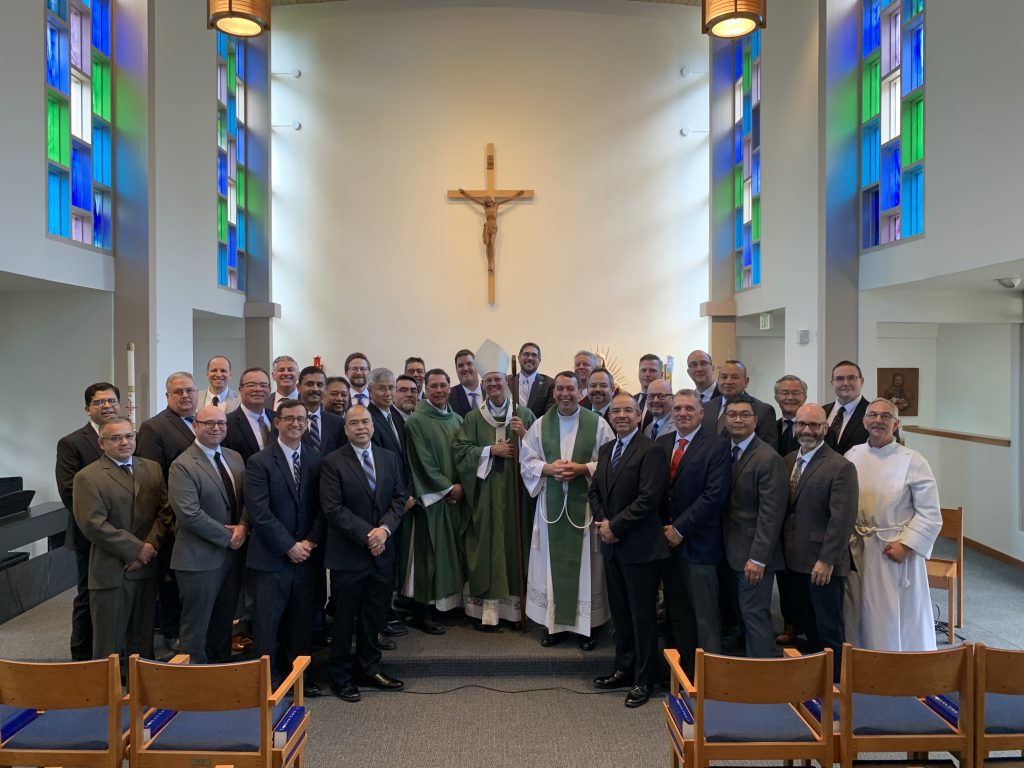
Today the Archdiocese of Seattle rejoices that 29 men in preparation for the Permanent Diaconate took a formal step in their formation process known as Admission to Candidacy for Holy Orders. In essence, the Church publicly recognizes their resolve and commitment to continue formation towards ordination as Permanent Deacons.
The retreat center chapel was on the verge of overflowing with these men, their families and friends and formation team who gathered for this Eucharistic celebration.
I wish to express my thanks to each of these men for their dedication. From the beginning when they were accepted into the formation program, they and their wives have demonstrated a deep faith and they quickly forged their own ‘personality’ as every class does. One of the formation team told me that this class is particularly close and have forged a strong cohesiveness. This bodes well for their ability to be agents of communion and unity in the Church.
In a special way, I wish to thank Fr. Michael Dion and our formation team for their good work accompanying and forming these men for service as deacons. Thus far, the class has completed two years of formation and they have three more years ahead before being called to Holy Orders. Please keep them in your prayers.
Below is the homily for today’s Mass.
In today’s readings, the first theme that seems to frame the others comes from Paul’s Letter to the Romans: “Oh, the depths of the riches and wisdom and knowledge of God! How inscrutable are his judgments and how unsearchable his ways!” Can we ponder this reality of God enough?!, especially when our world becomes too narrow – too small.
Next, we hear in both Isaiah and Matthew the reality of keys, binding and loosing, shutting and opening. Ultimately, these biblical images speak of authority – in Isaiah, the authority of a king; in Matthew, the authority of God. In each case, this authority is entrusted to others – in Isaiah to Shebna, who is being told his authority will be entrusted to another – Eliakim. In Matthew, Jesus entrusts this authority to the apostles through the person of Peter.
Finally, the context for the Gospel is also important. Jesus chooses to ask about his identity in a place that is filled with temples, altars and statues to all kinds of pagan God’s and to Roman Ceasars. It is in Caesarea Philippi Jesus chooses to ask about his identity: “Who do people say that the Son of Man is?” The apostles see around them evidence of the many false gods. It is here that St. Peter makes the all-important profession of faith to Jesus’ more specific question: “Who do you say that I am?” “You are the Christ, the Son of the living God.”
When Jesus entrusts the keys to Peter he is giving him authority. The keys do not represent privilege but rather responsibility. This privilege and responsibility are for service – a service to build up communion built upon truth. Ultimately it is the authority of Christ as the Son of the living God which is entrusted to the Church to extend the gift of salvation.
This gift of salvation stands in distinct contrast to one more phrase Jesus uses in today’s Gospel – that of the gates of the netherworld. Jesus calls Peter a rock upon which he is building the Church, and it shall not be overcome by the netherworld. One other interesting note from scholars: near Ceasarea Philippi there was a cave which was known as the gate to Hades, the portal to the underworld. It is here Jesus declares that not even death itself will overcome the Church he is building.
My friends, providentially, these are the readings that serve today as the backdrop for your admission to Candidacy for Holy Orders – namely, the permanent diaconate.
It is Christ who calls you to follow him in service to the Church. Thus, it is of extreme importance that you also be able to answer his question: “Who do you say that I am?” and once you arrive at the same understanding as Peter, you must then make the same proclamation: “You are the Christ, the Son of the living God.” This is the truth that is the source of salvation. This is the witness of the Church in a world that still has many false gods.
Additionally, you must be clear minded that a call to Holy Orders is not about privilege but rather is for responsible service.
“As you have already begun and now continue your formation you will learn each day to live according to the Gospel and to be strengthened in faith, hope, and charity. By practicing these virtues, you will grow in the spirit of prayer and in zeal to win more people over to Christ.”
“Compelled by the love of Christ and strengthened by the inner working of the Holy Spirit, you have arrived at a moment when you are to express your desire to be bound in Holy Orders for the service of God and God’s people. From this day on, you must cultivate more fully your vocation using especially those means that can be offered to you as help and support by the ecclesial community and the formators entrusted with this task.”
“On the part of all of us, trusting in the Lord, we will assit you with our love and prayer.”
“Therefore when you are called by name, please stand and declare your intention before the Church assembled here.” (Rite of Admission to Candidacy)
17