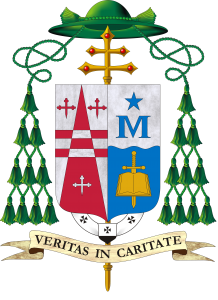
A Pastoral Letter
by Archbishop Paul D. Etienne
(PDF – English | Español | Tiếng Việt)
To the Clergy, Consecrated Religious, and Lay Faithful of the Archdiocese: Grace to you and peace in Jesus Christ our Lord.
+ May 2026
This devotion has its roots in the 17th century. But devotion to the Sacred Heart of Jesus is more timely than ever because, as Jesuit Father John Croiset has written, “properly understood it is nothing else than an exercise of love. Love is its object, love is its motive and principle, and it is love that ought to be its end.”
The Witness of St. Margaret Mary Alacoque
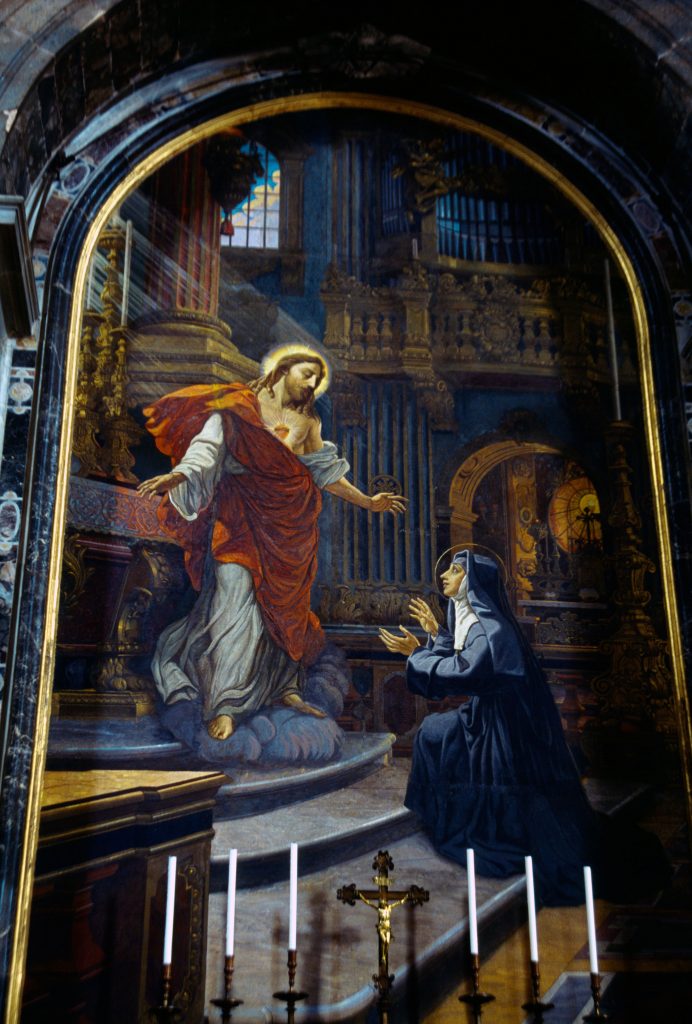
Between 1673 and 1675, Sister Margaret Mary Alacoque, a Visitation nun in Paray-le-Monial, France, experienced three great revelations in which Jesus shared with her the mystery of his heart — and through her, with the whole world. Jesus revealed his heart, on fire with love: “Behold, this Heart which has so loved human beings that it has spared nothing, even to exhausting and consuming itself, in order to testify its love.”
Jesus asked Sister Margaret Mary to receive Communion on the first Friday of each month, to pray in expiation for the indifference and ingratitude of so many for whom he died and to work to establish a feast in honor of the Sacred Heart on the octave day of Corpus Christi, the Solemnity of the Most Holy Body and Blood of Christ.
In the revelations made to Sister Margaret Mary, we see Christ’s response to the ingratitude of the human race: the revelation of his ardent love. The core principle of this devotion is the overflowing love of God, a merciful love that overcomes sin and evil. “Unable to contain within Himself the flames of His ardent charity, and yet not able to chastise His ungrateful creatures, He resolved to vanquish them by force of tenderness.” On the cross, Christ’s pierced side is opened, and his heart longs to come forth.
Growing Up with the Sacred Heart of Jesus
From St. Margaret Mary’s quiet convent in France, devotion to the Sacred Heart of Jesus spread rapidly across the world.
Like many of you, I grew up with this image and devotion.
I was blessed to grow up in a devout home. Our Catholic tradition holds that parents are the first teachers of their children in the ways of faith, and that was true in our family. I do not remember learning my prayers. I just grew up knowing them.
One early memory of childhood is praying together before every family meal. After the traditional grace before meals, we always prayed together the following Morning Offering, a prayer with its roots in devotion to the Sacred Heart.
O Jesus, through the Immaculate Heart of Mary,
I offer you my prayers, works, joys and sufferings of this day
for the intentions of your Sacred Heart, in union with the Holy Sacrifice of the Mass throughout the world in reparation for our sins, for all our associates, and in particular for the intentions recommended this month by the Holy Father.
Mary, Queen of Peace, pray for us. Amen.
Perhaps more than any other aspect of the devotion to the Sacred Heart of Jesus, this simple prayer has helped me learn to not only offer each day to the Lord, but also to be with the Lord in everything I do throughout the day. That is the ultimate goal of the devotion: to live in greater communion and intimacy with Jesus.
In the Church, devotions like the Sacred Heart are not just prayers to say: These devotions are meant to be lived. They are meant to draw us to greater union with Christ and, through him, to grow in the divine life of grace and holiness.
Besides the Morning Offering, another traditional practice of the devotion to the Sacred Heart is enthroning an image of the Sacred Heart in the home. On both sides of the family, my grandparents were devoted to the Sacred Heart. One set of grandparents had paintings of the Sacred Heart and the Immaculate Heart of Mary hanging in their dining room.
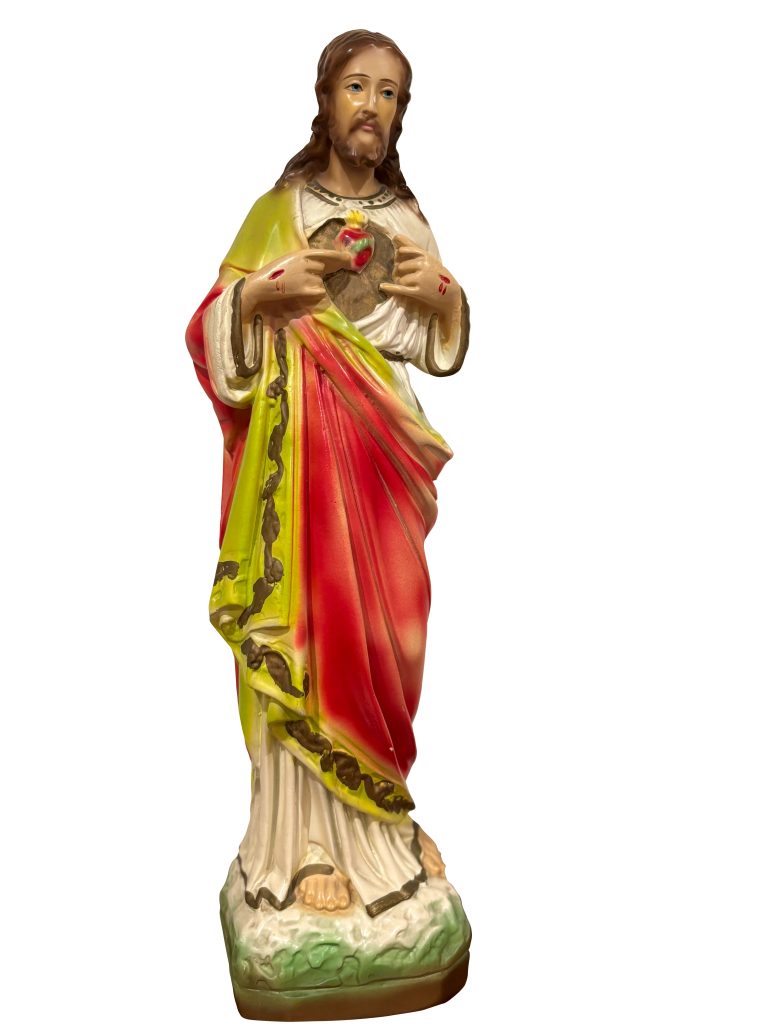
The other grandparents had statues of the Sacred Heart and of Our Lady of Grace on their bedroom dresser. I felt quite blessed to inherit them after my grandparents died. I still have the Sacred Heart statue (at left) on my bedroom dresser. Sadly, the statue of Our Lady did not survive the 2018 earthquake in Alaska!
These holy images are meant to be contemplated, to keep Jesus and his mother before us and to call them to mind frequently throughout the day. It is good to invoke the Lord with great confidence: Sacred Heart of Jesus, have mercy on us. Immaculate Heart of Mary, pray for us. As the Scriptures tell us: “Keep your eyes fixed on Jesus” (Hebrews 12:2).
In my own journey of faith, the devotion to the Sacred Heart has helped me draw closer to Jesus, to love him with heart, soul and strength (cf. Deuteronomy 6:4-9). That is why I am inviting all of us in this local Church to rediscover this beautiful devotion.
The Heart of Jesus: Revelation, Not Metaphor
When Jesus speaks of his heart in the Gospel, he is not merely offering a poetic image or inviting sentiment. He is revealing the interior truth of his person. In those words, “I am meek and humble of heart” (Matthew 11:29), the Son of God opens to us the deepest center of his human and divine life.
The Church’s devotion to the Sacred Heart arises precisely from these words of Christ. As the tradition — as documented by Jesuit Father John Croiset in the book “The Devotion to the Sacred Heart of Jesus” — makes clear, “The particular object of this devotion is the immense love of the Son of God, which induced Him to deliver Himself up to death for us and to give Himself entirely to us in the Blessed Sacrament of the altar.” The Heart of Jesus, therefore, is not an image to be contemplated, but a person to be known, a love to be received, and a mystery into which the Church is drawn.
When the Church speaks of the “heart” of Christ, we do not contemplate his heart separate from his body. As Pope Francis taught, “Devotion to the heart of Christ is not the veneration of a single organ apart from the Person of Jesus. What we contemplate and adore is the whole Jesus Christ, the Son of God made man, represented by an image that accentuates his heart.” When we speak of the heart of Christ, then, we are speaking of Christ’s immense love, which consumed his whole being.
True devotion to the Sacred Heart is devotion to the love of the Incarnate Son, crucified and risen, who gives himself entirely for the life of the world.
The Heart of Christ and the Wounded Human Heart
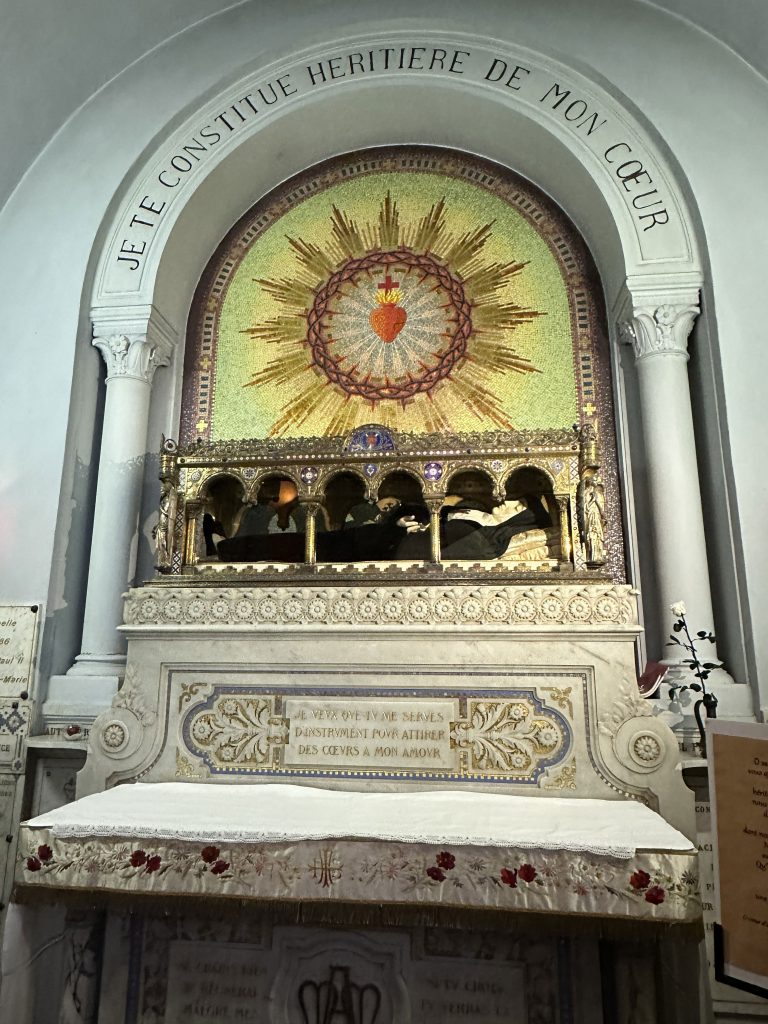
In the Gospels, Jesus consistently identifies the human heart as the center of moral and spiritual life: “From within people, from their hearts, come evil thoughts…” (Mark 7:21; cf. Matthew 15:19). The disorder of the world; the divisions within families, communities and even within the Church — these are not just structural or political problems. They begin in the human heart.
Devotion to the Sacred Heart speaks directly to this reality. It does so without naiveté, recognizing that the obstacles to conversion are often interior: tepidity, self-love, pride and passions left unchecked. The Sacred Heart is proposed not as a rebuke to our humanity, but as a remedy — the divine response to the wounded human heart.
In the revelation of the Sacred Heart, the Heart of Christ is revealed as full of love and mercy for us. From this heart flows the grace that alone can heal what sin has disfigured. In Christ, God does not merely call us to conversion; he gives a new heart.
I recall the words of Catholic writer Flannery O’Connor: “All human nature vigorously resists grace because grace changes us and the change is painful.” Christ came into the world precisely to give us this grace. Perhaps his love is what gives us the motivation to overcome this resistance and to receive and share the immense love of God: Heart speaks to heart.
Christ Dwelling in the Heart of the Believer
The New Testament deepens this mystery by proclaiming that the love revealed in the Heart of Jesus is not something external to us. St. Paul writes: “Christ lives in me” (Galatians 2:20) and “the love of God has been poured out into our hearts through the Holy Spirit” (Romans 5:5). Devotion to the Sacred Heart, rightly understood, is profoundly sacramental and ecclesial. It is ordered toward communion and unity: Christ dwelling in the heart of the believer and shaping the believer’s heart according to His own.
The purpose, then, of devotion to the Sacred Heart is not emotional consolation, but transformation. The ultimate goal of this devotion is that the heart of Jesus and the human heart become one. A mature Christian life is one lived in, with and for Christ — a life filled with, and motivated by, ardent love caught from Christ’s own loving heart. That love is what forms disciples, sustains fidelity and sends the Church on mission.
Reparation: Love Responding to Love
If devotion to the Sacred Heart begins in the revelation of Christ’s love, it leads toward reparation— not as a burden imposed upon the faithful, but as the proper response of love to love rejected. Reparation must not remain at the margins of Christian life, but at its very center, for it flows directly from communion with the crucified and risen Lord.
To speak of reparation is to acknowledge a sober truth: Love can be refused. St. John Fisher, the English bishop who was martyred in 1535, lamented that “we give no thought to his love, nor do we recognize the extent of his kindnesses to us … the remarkable mercy that he has continually shown to sinners does not move us to form our lives and conduct according to his most holy command.” Reparation is the Church’s refusal to remain indifferent where Christ’s love has been ignored, forgotten or despised.
Yet reparation is never an attempt to “add” to Christ’s saving work. Rather, it is the grace-filled participation of the baptized in his one sacrifice. As the tradition wisely counsels, “Unite the little which you do to the infinite amount which Jesus Christ accomplishes. Thus, while doing nothing yourself, you shall do much through Jesus Christ.” Reparation is not self-reliance; it is communion.
The Sacred Heart and Eucharistic Communion
The Heart of Jesus is revealed most fully where his love is most completely given: in the self-offering of the cross and in the permanent gift of the Eucharist. As the Church teaches, “The immense love of the Son of God … induced Him to deliver Himself up to death for us and to give Himself entirely to us in the Blessed Sacrament of the altar.”
Devotion to the Sacred Heart is inseparable from Eucharistic faith, for the Eucharist is the privileged place where the Church encounters the living Heart of Christ. In every celebration of the Mass, the same love that beat in the Heart of Jesus on Calvary is made present sacramentally and offered anew for the life of the world. Eucharistic communion, therefore, is not only reception; it is conformation — the shaping of our hearts according to his.
Devotion to the Sacred Heart finds its most authentic expression here. The Eucharist is the sacramental locus of this treasury, where Christ gives not something of himself, but himself entirely.
For this reason, frequent Communion, Eucharistic adoration and the offering of daily life in union with the Mass are not just optional devotional practices; they are concrete ways in which the faithful learn to live from the Heart of Christ.
Such communion bears fruit in peace. Where hearts are formed by Eucharistic communion with the Sacred Heart, division gives way to reconciliation, indifference to charity and fear to hope. St. Paul exhorts the Church: “Let the peace of Christ control your hearts” (Colossians 3:15).
All of this calls for interior conversion. Without the right interior dispositions, devotion risks becoming merely performative or routine. But with them, our devotion can become transformative. In an age of distraction and spiritual fatigue, interior recollection is itself an act of reparation. To place the Heart of Jesus before one’s eyes — whether through Eucharistic adoration or through contemplation of a sacred image — is not escapism. It is an act of resistance to a culture that no longer knows how to dwell with love.
The Sacred Heart and the Mission of the Church
The love revealed in the Sacred Heart of Jesus is never self-referential. It is, by its very nature, missionary. The Heart that was opened on the Cross remains open in the life of the Church, sending her forth as a sacrament of Christ’s love for the world. True devotion to the Sacred Heart does not withdraw the believer from the world but configures the Church for her evangelical mission.
This missionary character flows directly from the inner logic of the Gospel. Jesus said: “Where your treasure is, there also will your heart be” (Matthew 6:21). When the Heart of Christ becomes the treasure of the Church, her mission takes on his form— marked by humility, mercy, patience and self- giving love. Evangelization ceases to be strategy and becomes witness, born of communion.
The Church does not invent her mission; she participates in the mission of the Son of God, Jesus. St. Paul expresses this with radical clarity: “I live, no longer I, but Christ lives in me” (Galatians 2:20). The apostolic life is possible only because Christ first gives himself interiorly, dwelling in the hearts of believers through faith (cf. Ephesians 3:17). Devotion to the Sacred Heart keeps this truth before the Church.
The tradition insists that the Heart of Jesus is “the treasury of all supernatural gifts and of all graces.” Mission does not arise from human zeal alone, but from abiding in this treasury. The Church evangelizes effectively only to the extent that she draws from the inexhaustible love of Christ and allows that love to shape her words, her works and her witness. Mission without communion is merely activism.
This has concrete implications. Where the Sacred Heart is known and loved, families find unity, communities are reconciled and hardened hearts are softened — not by force, but by mercy. The tradition speaks of the fruit of devotion to the Sacred Heart, “to establish union and peace in the most divided families” and “to obtain victory over the strongest passions.” These are not private benefits; they are evangelical signs in a fractured world.
An Invitation to the Church Today
“Publish this devotion everywhere,” Christ said to St. Margaret Mary, as “a sure and easy means to obtain … a true love of God” for the faithful and “an efficacious means to arrive at the perfection of their state” for clergy and religious. These words of Jesus to St. Margaret Mary are addressed to the Church of every age.
Today, the Lord entrusts this devotion anew to the Church. In a time marked by division, weariness and a loss of confidence in love itself, the Sacred Heart of Jesus remains what it has always been: the revelation of who God is and who we are called to become.
Earlier this year, Pope Leo XIV stated: “In the face of the many questions of the human heart, as well as tragic situations of injustice, violence and suffering that mark our time, our faith needs to be alert, attentive and prophetic. Faith should open our eyes to the darkness of the world, and bring others the light of the Gospel through our commitment to peace, justice and solidarity.” Devotion to the Sacred Heart of Jesus does not close us off from the realities of the world but opens our eyes to the needs around us.
In every age, the Church must ask not only what she proclaims, but with what heart she proclaims it. The Sacred Heart of Jesus provides the answer. The Church is sent into the world bearing not an abstract message, but a living person — Christ himself — whose heart remains gentle and humble, even when rejected.
In a culture often suspicious of truth claims, yet deeply wounded by lovelessness, the Sacred Heart reveals what credible evangelization looks like: truth spoken in charity, mercy offered without compromise and fidelity lived with patience. The Church does not persuade the world by power, but by love made visible.
Devotion to the Sacred Heart must never be relegated to the past or confined to a particular spirituality. It belongs to the Church’s present mission. It forms priests after the Heart of Christ, strengthens families as domestic churches and sustains the faithful in works of justice, mercy and evangelization. In short, it shapes a missionary Church whose heart beats in unison with the Heart of her Lord.
An Exhortation and Entrustment
Today, the Sacred Heart of Jesus continues to stand before us not only as a mystery to be
contemplated, but as a life to be embraced. The Lord who reveals himself as “gentle and humble of heart” continues to invite his Church to learn from him — not in theory, but in the concrete rhythms of daily Christian life.
As a nation soon to be consecrated to the Sacred Heart of Jesus, I ask: What would it look like for us as a nation to live this consecration — mutual love, respect for persons, loving the neighbor, working for peace?
I therefore exhort all the faithful of this archdiocese to embrace a devotion to the Sacred Heart of Jesus in ways that are simple, ecclesial and enduring, so that faith may take root not only in our words, but in our homes, our parishes, and our daily offering of life.
To families, I say: Let the Sacred Heart reign in your homes. In a culture that often weakens commitment and obscures love, the Heart of Jesus remains a sure refuge and a school of fidelity.
I encourage families and individuals to enthrone an image of the Sacred Heart of Jesus in their homes, placing before their eyes a visible reminder that Christ is the center of family life and the source of mercy, forgiveness and peace. Such a practice quietly but powerfully shapes the heart, forming the home as a domestic church where love is learned, sustained and given.
I also commend to all the daily Morning Offering, by which the faithful consciously unite their prayers, works, joys and sufferings to the sacrifice of Christ offered throughout the world. This simple act places the whole of life within the Heart of Jesus, teaching us to live not for ourselves, but with Christ and in Christ.
I urge parishes and the faithful to reclaim the First Friday devotion, rooted in participation at Mass and reception of holy Communion in a spirit of reparation and love. In returning regularly to the Eucharistic Heart of Jesus, the Church learns again that her strength does not come from herself, but from Christ who gives himself entirely for the life of the world.
These practices are not burdens imposed from without. They are paths of freedom, helping us resist spiritual fatigue, forgetfulness and division. They guard against a faith that remains abstract and, instead, form hearts capable of love — ardent, faithful and missionary.
To priests and deacons, I offer a particular exhortation. You are called to shepherd the people of God after the Heart of Christ. I ask you to lead by example, drawing from the Eucharistic Heart of Jesus the charity, patience and humility that sustain pastoral ministry. In a time of complexity and strain, return often to the Heart from which your vocation flows.
To the young, the poor, the sick and all who carry heavy burdens: Know that the Heart of Christ is open to you. He is not distant. He is near, merciful and faithful.
As your bishop, I entrust our archdiocese, our families, our parishes and our mission to the Sacred Heart of Jesus. The desire of Christ’s Sacred Heart is our transformation and conversion. The end goal of this devotion is greater love — that we may love as we have been loved first by Christ. (See1 John 4:19.)
May this love renew our faith, purify our hearts and send us forth as witnesses of hope in a world in need of mercy.
It is fitting to call to mind Bishop A.M.A. Blanchet, the first bishop of our archdiocese. Bishop Blanchet’s motto was “O cor amoris victima” (“O heart, victim of love”) and his coat of arms was an image of
the Sacred Heart. When he placed the Blessed Sacrament at Vancouver for the first time, he wrote, “His eyes and His heart will always be here.”
May God always fill us with the love of Christ and lead us to and strengthen our love for His Most Sacred Heart!

Most Reverend Archbishop Paul D. Etienne, DD, STL
Archbishop of Seattle