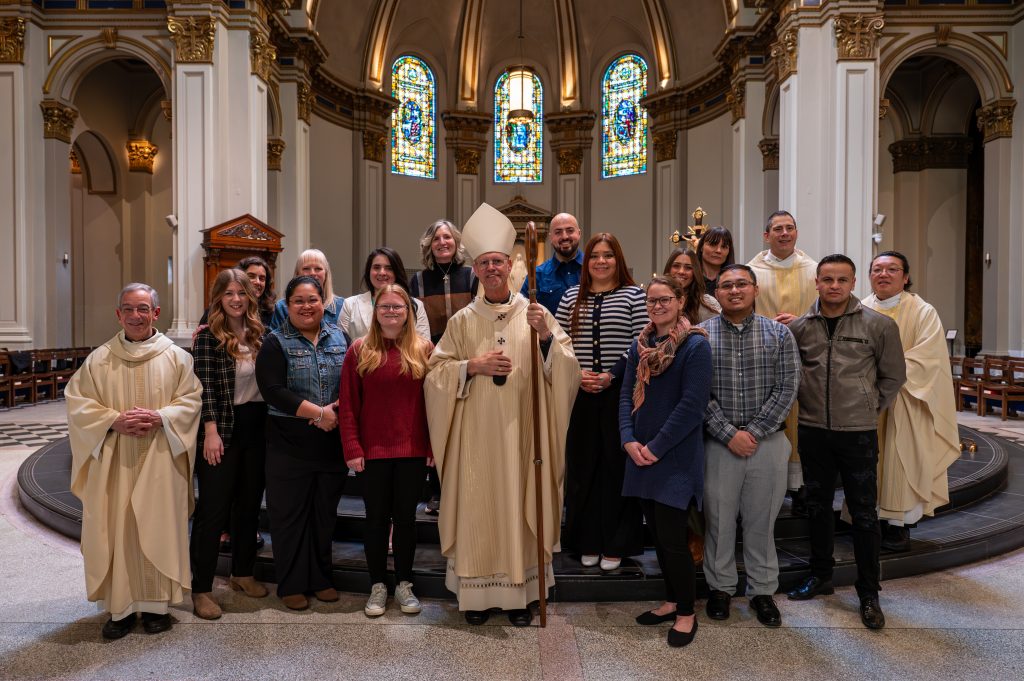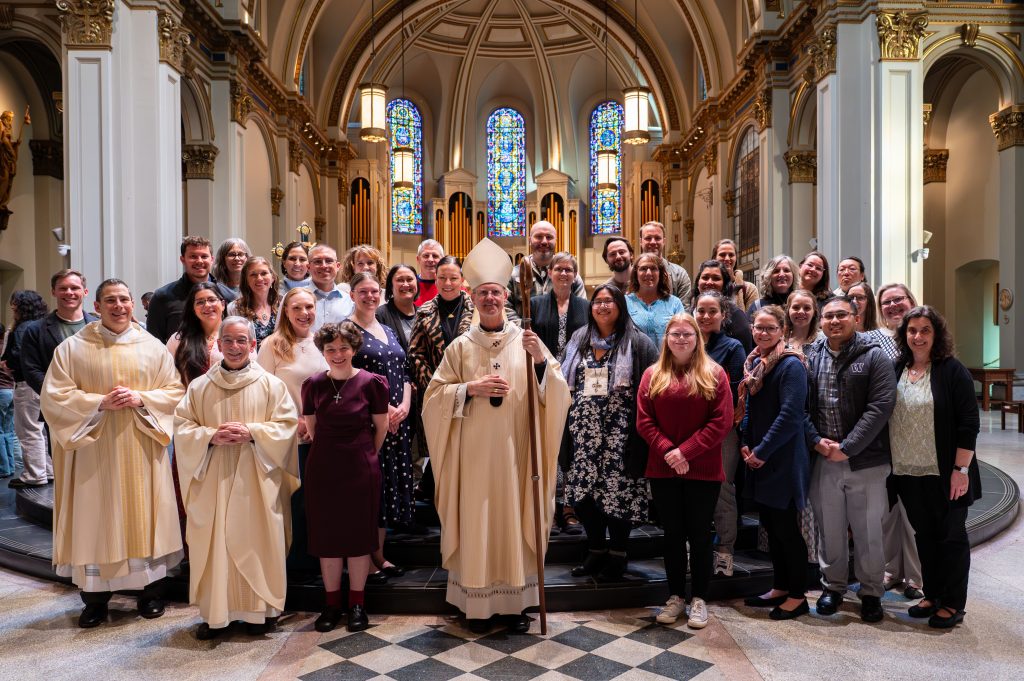
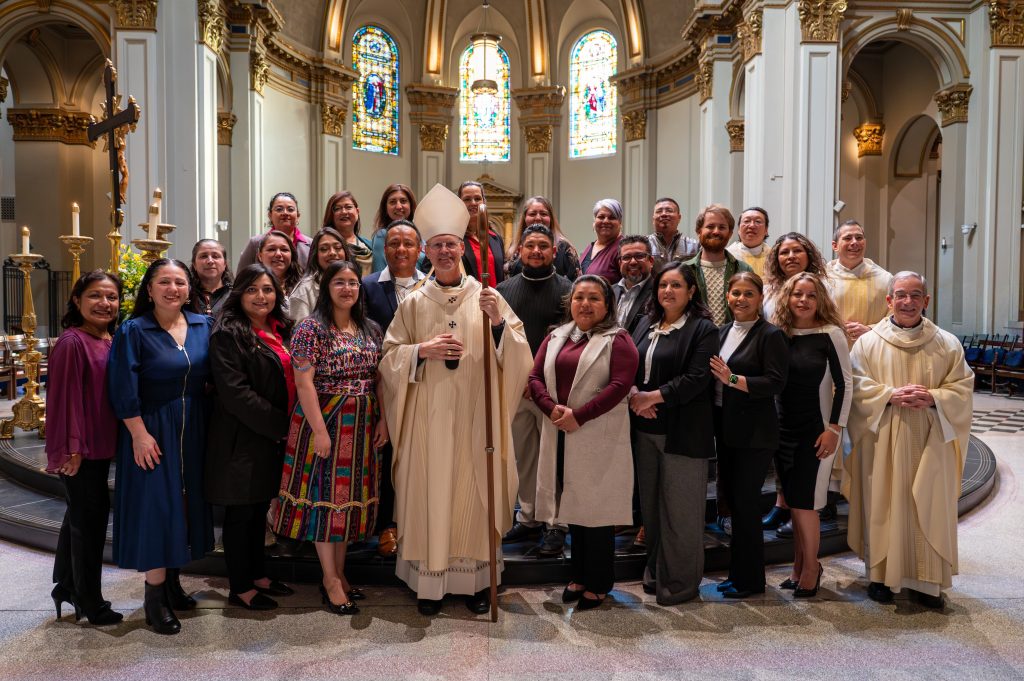
Last Saturday we celebrated the graduation of several lay men and women from our Christifidelis Formation program. Those pictured above are enrolled in our Masters in Theological Studies. The program also offers certificates for ministry. Those honored Saturday included one group who received certificates for Youth and Young Adult Ministry and another group who received certificates for Hispanic Ministry.
It is so encouraging to see more lay men and women who are not only engaging in a formal ministry in the Church but are taking time to be better formed in the heart and mind of the Church. As I told them at the end of Mass, they are helping us become more fully the Church envisioned by the Council Fathers of the Second Vatican Council.
Below you can find the homily from Mass.
Micah 6:8 “to walk humbly with God”
Ant. 1: Whoever humbles himself like a child will be greatest in Kingdom of Heaven
We walk with God in this present life – in this world. Here and now we are called to humility and to love with the very heart of God.
The Fathers of the Second Vatican Council challenged us to be sensitive to the signs of the times. This is so very important for us today in this rapidly changing society. What does it mean to walk humbly with God in today’s context? Most of you who are graduating today were raised in a different time and culture than I was. And most of those you are now going forth to serve were raised in yet a different culture.
What is an accurate understanding of today’s society? And how do we as ministers of the Gospel effectively evangelize in this new generation with courage, confidence and competence?
We are not so much living in a post-Christian world; more accurately we are now in a period better called postmodernity. In his book Post Leo XIV, Jesús Colina describes postmodernity this way:
Postmodernity is characterized by an attitude of skepticism toward general narratives that attempt to explain broad aspects of human experience and history, especially religion. This leads to a relativistic perspective that values diversity of opinion and questions the existence of universal truths, privileging individual or cultural interpretations of reality. It emphasizes the importance of cultural, ethnic, sexual, and gender diversity, rejecting binary classifications and encouraging the recognition and appreciation of multiple identities and perspectives. (p. 54)
Colina also distinguishes appropriately between post-Christianity and post Christendom. We are not in a post Christian world. Indeed, here in the Archdiocese of Seattle there is a strong presence of active believers in Jesus Christ! Thus, this is not a post-Christian world. But we are in a period of post-Christendom. But what does Christendom mean?
Turning again to Colina he defines Christendom in these terms:
Christendom refers to the cultural, political, and social influence of Christianity as a dominant force, especially in areas where it shaped laws, culture, and governance. Christendom emphasized a unified identity among diverse peoples and nations under the banner of the Christian faith, despite the reality of differing interpretations, practices, and political ambitions among them. (p. 52)
Pretty clearly, this does not define our present reality.
I share these brief observations with you because we need to have clarity about the environment and culture into which Jesus sends us as his beloved disciples. This clarity is essential for our mission effectiveness.
One other recent personal experience speaks to the truth of these observations. I recently participated in a conference on Deepening Communion in a Polarized World at St. Meinrad Seminary. Present for the first day were both the monastic and seminary communities. One of the speakers addressed the issue of the present culture, especially the reality of the transient nature of things in a postmodern world. At one point he said that for our young people today, it is like living in a river of fluid modernity, where nothing seems to have meaning. That is not a direct quote, but close. When he said it there was an audible gasp from the young seminarians – indicating that he spoke directly to their experience.
This tells us that young people are yearning for stability, meaning, value and purpose. Indeed, these are the yearnings of every human heart because this is how God creates us in his image, writing his eternal laws upon our hearts. This is why a clear presentation of the Gospel is essential and there is no more profound instruction than one’s witness of life.
My dear graduates, as you now discern what may be next or perhaps as you continue in your ministry with newfound knowledge and formation, I have three simple words for you.
Pray – Study – Serve.
In today’s Gospel, Levi, better known today as St. Matthew, discovered a life-changing relationship with Jesus, and followed him. Prayer takes us ever deeper in this life-journey with Jesus who gives meaning and purpose to all we do, indeed life and salvation. Pray and stay with Jesus.
Life-long formation includes regular reading and study. In these days I highly recommend you read and study the four main constitutions of the Second Vatican Council. As Pope Leo recently stated, the Council is our North Star.
Finally, serve God’s people with a generous heart. Study helps us remain in communion with the broader Church. Prayer helps us receive the love and mercy of Jesus. Together, prayer and study help us to serve with the very heart of God. That is your mission. That is our mission.
Go forth, walking humbly with God, acting justly and loving tenderly with God’s own heart.