Tuesday, February 17 marked this year’s celebration of Lunar New Year. This is a significant moment in the life of much of the Asian community.
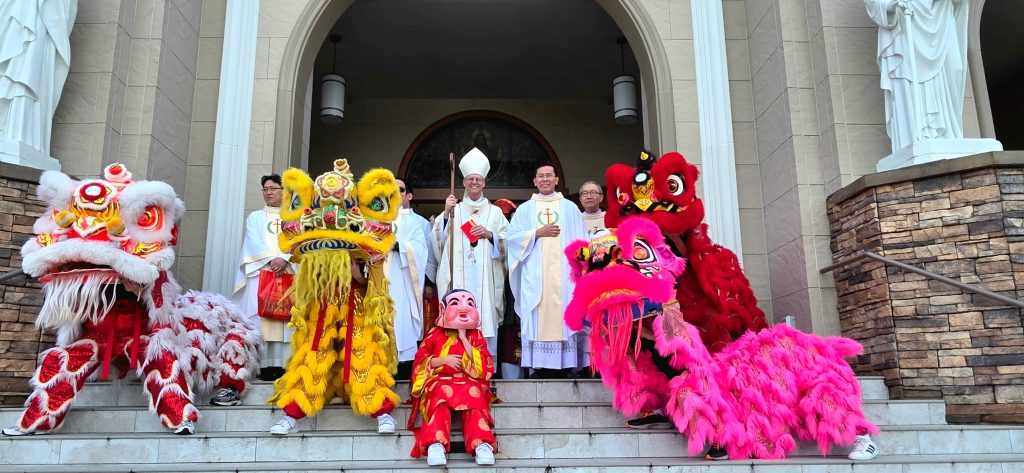
Last Saturday I celebrated the Lunar New Year with the Vietnamese Catholic Community at the Vietnamese Martyrs Parish in Tukwilla. Normally the celebration extends for at least a week, including Masses, prayer services and lots of festivities depending upon the culture.
I find it providential this year’s Lunar New Year coincides so closely with Lent. Making New Year’s resolutions and focusing on the spiritual practices of Lent seem to go hand in hand.
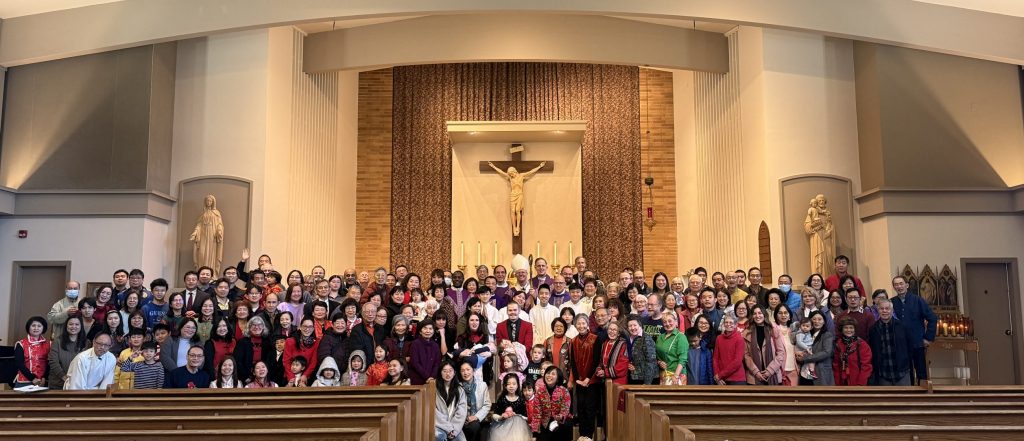
Today I celebrated with the Chinese Catholic Community at St. Monica on Mercer Island. After Mass there was a lovely ceremony to venerate their ancestors followed be a reception with lots of food.
Below you can find the homily for this Mass on the First Sunday of Lent.
Brothers and sisters in Christ,
The readings this weekend give us foundational instruction about who God is as Creator and Redeemer, and who we are as the human person created in God’s image. We are created infinitely good, for communion with God, yet we live with the consequences of original sin, contracted through our first parent, Adam. By the love and mercy of God, however, through the Incarnation, life, death, and Resurrection of Jesus Christ, we are also the beneficiaries of unmerited mercy and saving grace.
The creation account in the Book of Genesis—though not a scientific explanation nor a myth—offers what the Church calls a divinely inspired account of the “primeval event … that took place at the beginning of the history of man” (CCC 390). From these passages we profess several essential truths of faith:
- God is the sole Creator of the human person; the human soul is directly created by God.
- Humanity was created in a state of original holiness and justice.
- Human beings were created for communion with God.
- Creation itself has order, harmony, and purpose (CCC 337, 355–359, 374–379).
The presence of the tree of the knowledge of good and evil, and God’s command not to eat of its fruit, reveals something crucial about our identity. This command is not arbitrary. It reveals that by our very creation there exists a moral order intrinsic to being a creature—an order that expresses our dependence upon God and the truth that we do not define good and evil for ourselves. To live in communion with God is to live in trust, obedience, and filial dependence.
The serpent, representing Satan, tempts Adam and Eve not simply to disobedience, but to moral autonomy—to believe that life and freedom are found apart from God. The tragedy of the Fall is not merely the eating of fruit, but the rupture of trust: humanity choosing self over God, autonomy over communion.
This pattern is not confined to the past. Every sin, in some way, repeats this same choice: Will I trust God, or will I decide for myself what is good?
Yet the Church gives us these readings at the beginning of Lent not to leave us discouraged, but to call us to renewal. One essential step in renewal is the honest acknowledgement of sin—not with fear, but with hope. As St. Paul reminds us, “through one righteous act acquittal and life came to all” (Romans 5:18).
The Gospel today shows us that Jesus enters the desert not as a distant observer, but as the New Adam, contending with Satan on our behalf. Where Adam fails in a garden of abundance, Christ remains faithful in a desert of hunger. Where Adam grasps, Christ trusts. Where Adam listens to the voice of the tempter, Christ clings to the Word of God.
Jesus does not merely resist temptation—He reorients humanity. His obedience restores what was lost. His fidelity opens a new way of life. This is why St. Paul can proclaim:
“But the gift is not like the transgression. For if by the transgression of the one the many died, how much more did the grace of God and the gracious gift of the one man Jesus Christ overflow for the many.”
Lent, then, becomes a school of freedom—not freedom as self-assertion, but freedom as the capacity to choose the good. To live a strong, moral faith life this Lent, here are a few suggestions:
- Practice daily trust: Begin each day acknowledging dependence on God through prayer. Even a brief morning offering reorders the heart.
- Strengthen moral clarity: Let Scripture and the teaching of the Church shape conscience, rather than emotion or convenience.
- Embrace spiritual discipline: Fasting trains us not to be ruled by appetite; almsgiving loosens our grip on self-centeredness; prayer deepens communion.
- Resist moral isolation: Faith is strengthened in community—seek reconciliation, Eucharist, and accountability.
- Do not fear struggle: Temptation is not failure. It is the place where grace is exercised and virtue grows.
We are no longer trapped in Adam. Through Baptism, we live in Christ—still engaged in spiritual battle, but no longer alone.
It is providential that the Lunar New Year coincides with the beginning of Lent. Both invite renewal. This season offers us a grace-filled opportunity to recommit ourselves—not to perfection, but to faithful dependence on God, who alone gives life.
May this Lent lead us not merely away from sin, but more deeply into communion with the One who is our Creator, Redeemer, and true freedom.
0