Tonight, once again, we gather as Church, a small portion of the Body of Christ. The Fathers of the Second Vatican Council teach us that the Church “is an enduring source of unity, hope and salvation for the whole human race. It is established by Christ as a communion of life, of love and of truth.” (Lumen Gentium no. 9)
When one reads the Gospels, it becomes clear that the majority of Jesus’ ministry involved healing, whether of the body or the spirit. His greatest healing was that of freeing the whole of humanity from the death of sin through the redeeming work of his passion, death and resurrection.
The Chrism Mass begins not with us, but with Jesus Christ, the Father’s Anointed, upon whom the Spirit rests in fullness. Jesus applies Isaiah 61 to himself in the synagogue: “The Spirit of the Lord is upon me, because he has anointed me…” (Lk 4:18; cf. Is 61:1–3).
Through his anointing, Jesus is sent into the world to “bring glad tidings and to give the oil of gladness.” This gladness is not superficial happiness, but the deep joy of obedience to the Father, even when that obedience leads to suffering.
Pope Leo XIV insists that Christian joy does not exclude wounds: During his Oct. 8 general audience at the Vatican, the Holy Father said “there is an obstacle that often prevents us from recognizing Christ’s presence in our daily lives: the assumption that joy must be free from suffering. Pain is not the denial of God’s promise. Pain, if inhabited by love, can become a place of communion.” (General Audience, Oct. 8, 2025)
Lumen Gentium teaches that the Church is “in Christ like a sacrament”—a visible participation in Christ’s own life and mission (LG 1). The Church does not merely represent Christ; she shares in his anointing through the Spirit poured out at Pentecost.
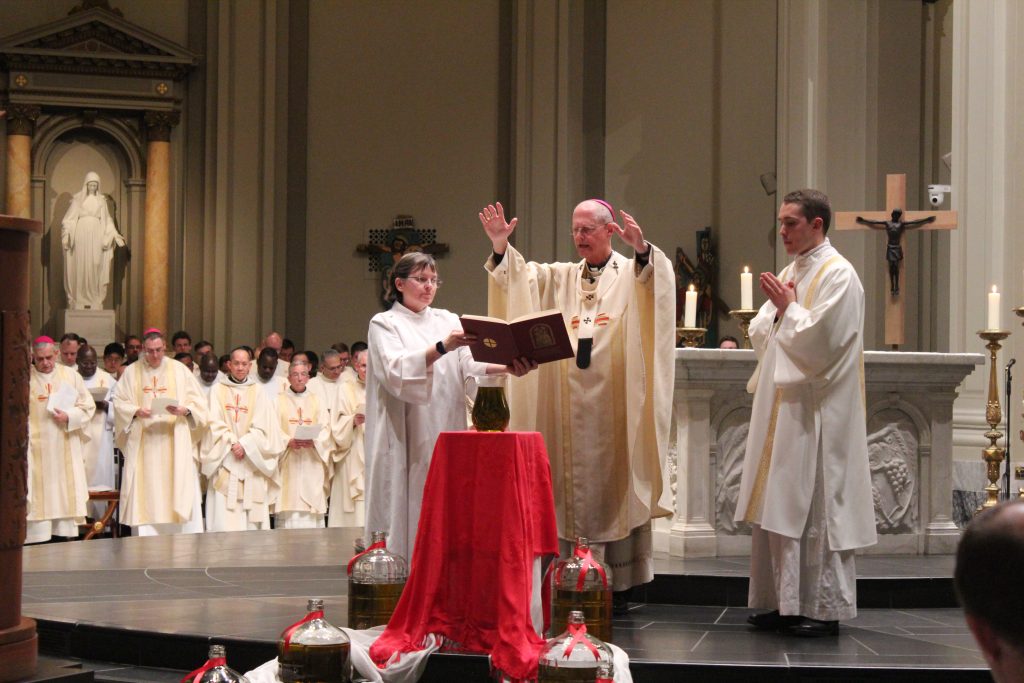
Thus, the sacred oils consecrated today are not magical objects, but sacramental signs of the Church’s participation in Christ’s sanctifying work. All the baptized have been anointed by Christ to participate in the sanctifying mission of the Church.
Priests, however, share an additional anointing through the sacrament of Holy Orders. Thus, the ministerial priesthood differs in essence, not merely degree, because it acts in persona Christi (LG 10). Priests are anointed not for status, but for sacrificial service, especially at the Eucharist, where Christ’s Paschal Mystery is made present.
Pope Leo XIV, reflecting on Lumen Gentium, emphasizes that hierarchy exists to serve communion and mission, not power: “The hierarchical structure is not a human construct… but a divine institution whose purpose is to perpetuate the mission given by Christ.” (General Audience, March 25, 2026)
Christ is the Man of Sorrows, yet also the one anointed with gladness—because love carried him through the Cross.
Pope Leo XIV returns often to this truth: “No fall is definitive, no night is eternal… Christ’s resurrection teaches us that no history is so marked by disappointment that it cannot be visited by hope.” (General Audience, Oct. 8, 2025)
For priests especially, weariness, misunderstanding, and hidden suffering are not signs of failure, but places where priestly anointing becomes most transparent. Perseverance itself becomes sacramental; a living witness that Christ is faithful.
My brother priests, I know your life and ministry as priests is demanding, and even more so as we usher this local Church through a necessary reorganization process. I know the broader realities of the world also have devastating effects on our people and ultimately on you. The ministry at times indeed becomes burdensome.
Brothers, please know I understand and share that burden with you in my own episcopal ministry. These are not complaints, but a simple recognition of our present reality. I am grateful to bear the weight of the priestly stole with you because you are a great presbyterate for which I am deeply grateful!
As we journey together as a People of God, and especially as one presbyterate dedicated to their service, I wish to point to Pope Leo XIV for a few practical examples for our priestly life. He is a man of deep prayer who understands the importance of regular silence and meditation. He also demonstrates tremendous patience as he methodically and deliberately makes decisions. And he gives a great example by taking a day off each week!
Brothers, take care of yourselves, spiritually and physically, and take care of one another. We need each other.
Each Chrism Mass invites priests to renew their promises and to remember a fundamental truth: this ministry cannot be sustained by our own strength. We are able to fulfill the call Christ gives us only insofar as we remain dependent upon him and confident in his faithfulness. Even if we possess every gift for priesthood, if our strength is not found in Christ, we become false prophets rather than true servants of the Gospel.
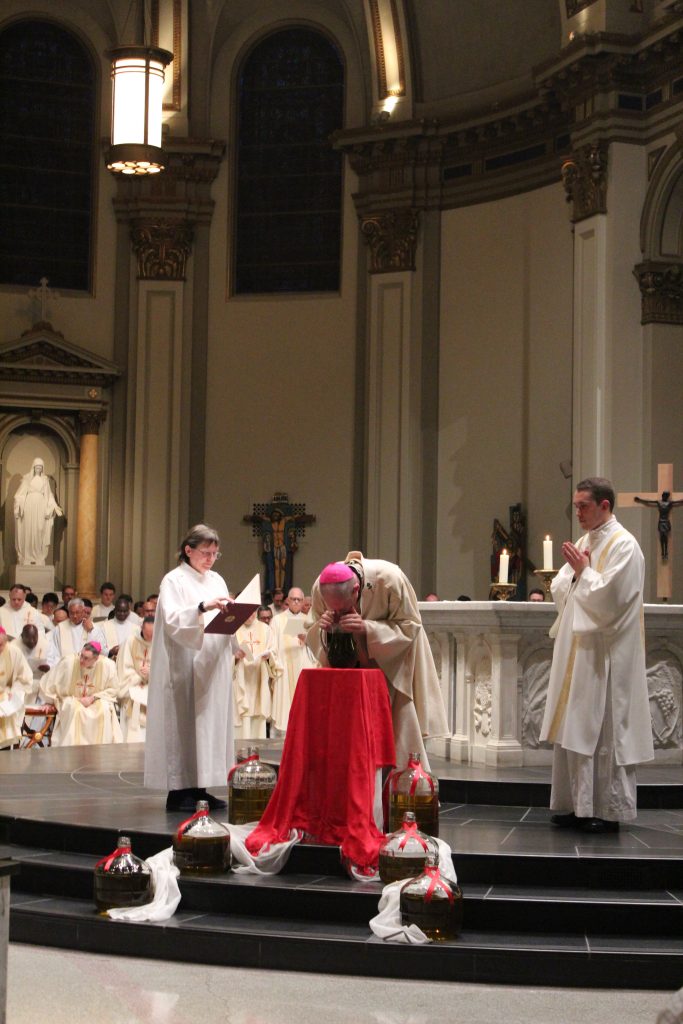
The oils we bless and consecrate tonight remind us that the Church continues Christ’s work through fragile instruments—earthen vessels bearing divine treasure (cf. 2 Cor 4:7).
From the head of Christ flows the oil that reaches the hem of his garment (cf. Ps 133).
No matter the oil or the sacramental occasion, it is Christ, through the Church, still at work in our world.
As members of the Body of Christ, our Anointing becomes mission. Our Suffering becomes hope. Our Perseverance becomes joy.
Along the journey of faith, we are conformed more and more to Christ, and, please God, through us, the Light of Christ will burn more brightly in the darkness of our world. The Truth of Christ will establish justice. And those in need will find in us a willing hand to free their burden and lift them once again to their dignity of life.
Sacred Heart of Jesus, Have mercy on us.
Immaculate Heart of Mary, pray for us.