It is hard to believe we first started discussing Partners in the Gospel over four years ago. In my first ‘tour of the Archdiocese’ after becoming the Archbishop in September of 2019, the resounding concern expressed to me by the priests was the number of parishes to pastor with a dwindling number of priests. In 2021 it became clear ‘the status quo was no longer an option’.
Chancery staff and the Presbyteral Council began working with a consultant to review vast amounts of information to better understand our present situation in order to draft a plan to address current trends and faith practices.
Once we announced the ‘parish families’ and the initial implementation phase began in 2024 we have gathered the pastors to help them understand each phase of implementation. We gathered again Wednesday and Thursday of this week for what will more than likely be the last time as we enter this final phase of parish reorganization in the Archdiocese of Seattle.
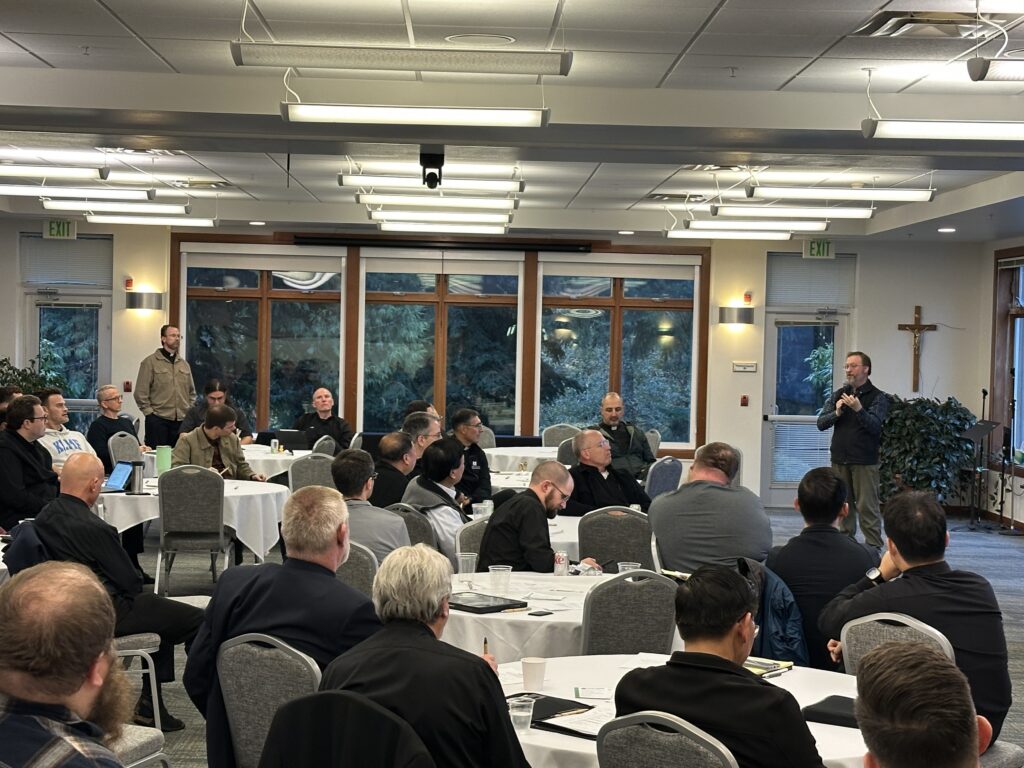
We celebrated Mass each day which gave me an opportunity to preach about the real focus of this effort, which is the renewal of our life in Jesus Christ and to more effectively carry out his mission in and through the Church. I wish to share the two homilies with you here. Admittedly, this is a long post, but there are some important scriptural reflections to guide all of us in these months ahead as parishes begin to complete and submit their one parish plans for review.
During the final meeting of the day yesterday the significance of this effort came into clear focus. I am deeply grateful to so many people for the amount of prayer, discernment and hard work that have brought us to this point in time. I am tremendously grateful for the strong faith-community of this Archdiocese of Seattle. While life always changes, our faith in Jesus Christ remains a constant! Let us move forward with hope as we embrace our new reality.
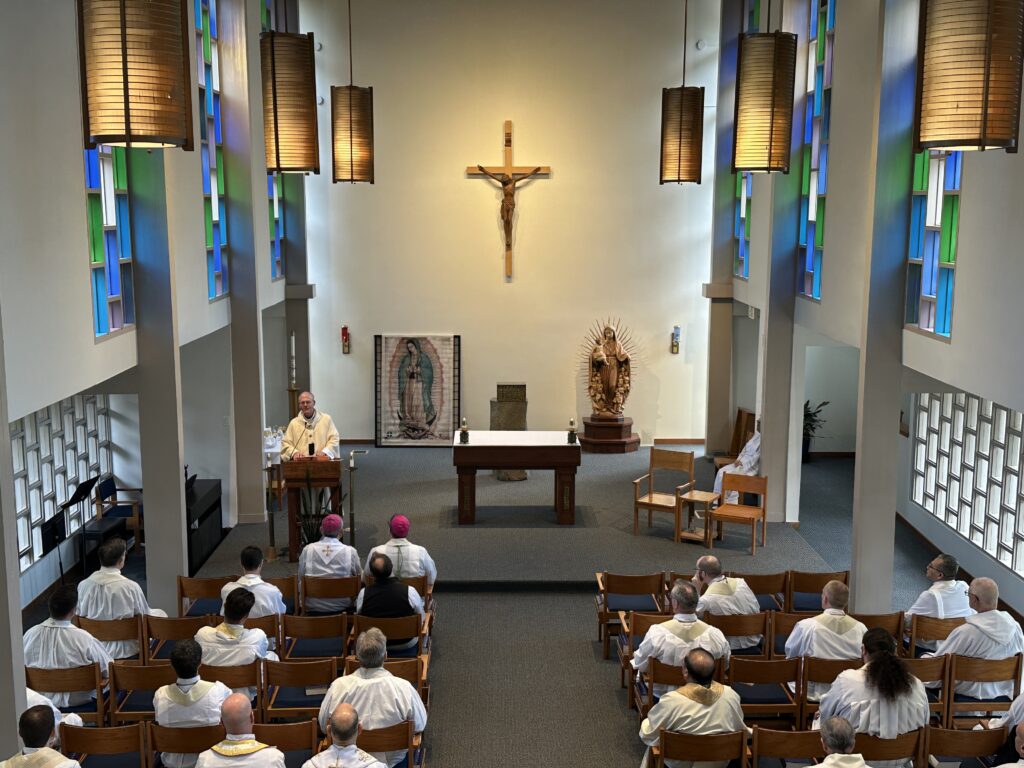
Wednesday, +St. Charles Borromeo: Philippians 2:12-18; Psalm 27; Luke 14:25-33
Brothers,
There are a few words in today’s Scriptures that perhaps strike a little closer to home than usual. Paul tells the Philippians: “Be obedient,” and then, perhaps even more dangerously for a bishop to quote in the midst of reorganization: “Do everything without grumbling or questioning.”
I promise you, I did not choose the readings!
But Paul is not asking the Philippians for blind obedience. And he certainly is not saying that faithful disciples never have questions, concerns, or disagreements. He is speaking about something deeper: the obedience of faith. The willingness to trust that God is at work, even when the path before us is difficult, uncertain, or not the path we ourselves would have chosen.
Paul says: “Work out your salvation with fear and trembling. For God is the one who, for his good purpose, works in you both to desire and to work.”
That is an important word for us today.
We are doing a great deal of work these days. There are plans to make, structures to reconsider, difficult conversations to have, expectations to manage, communities to accompany. There is understandable anxiety. And there is loss.
But beneath all of our work, God is at work. And perhaps that is the invitation of this moment: to believe that this reorganization is not simply something we have to get through. It can also become a moment of conversion, purification, and renewal.
Because the goal is not simply better organization. The goal is greater faithfulness to the mission of Jesus Christ. And that leads us directly to the Gospel.
Jesus uses startling language today about discipleship: loving him above father and mother, wife and children, brothers and sisters, even our own lives. He tells us to take up the cross. He tells us that we must be willing to renounce our possessions.
Jesus is reminding us that discipleship always involves letting go. And I think that may be one of the spiritual invitations before us right now. We are being asked to let go of some things we have known:
Some familiar ways of serving. Some structures that have supported parish life for generations. Perhaps even some expectations about what priesthood and pastoral leadership would look like for us.
And letting go is never easy. But Jesus is very clear: We cannot follow him without carrying the cross. The cross is not simply suffering for suffering’s sake. The cross is what love looks like when love costs us something.
And I see that costly love in you. I see it when you listen patiently to parishioners who are worried about the future. I see it when you carry the anger or disappointment of people who love their parish deeply. I see it when you are asked to collaborate in new ways, to share responsibility, to build relationships across communities, and sometimes to surrender things you would rather hold onto.
And I want you to know something today: I am grateful to you. I know this is not easy. I know that some days there is probably some grumbling and questioning. There may even be a little in the chancery!
But I also know the generosity with which you continue to serve the people entrusted to your care. And that is why another phrase from Paul seems particularly important today: “Hold fast to the word of life.” Not hold fast to our structures. Not hold fast to our plans. Not hold fast to the way things have always been. Hold fast to Christ.
Because ultimately, that is what this moment asks of all of us. It asks us to put Christ first, before our preferences, before our comfort, before the parish we have known, before our own vision of how things ought to be.
It asks us to live more simply. It asks us to listen more deeply. It asks us to trust one another. And it asks us to believe that the Holy Spirit can create something new even through uncertainty and loss.
Paul says that if the Philippians live this way, they will “shine like lights in the world.” That is my prayer for us. Not simply that we successfully reorganize the Church in Western Washington, but that through this process, we become more clearly the Church Christ is calling us to be.
A Church less concerned with preserving itself and more concerned with proclaiming the Gospel. A Church whose priests and people know that we belong first to Christ. A Church willing to sacrifice for the sake of mission. A Church in which people can look at the way we love one another, bear with one another, forgive one another, and serve together, and see something of Jesus Christ.
Brothers, thank you for your leadership. Thank you for your patience. Thank you for carrying a cross that your people do not always see. And thank you especially for continuing, in the midst of all of this, to hold fast to the word of life.
We do not know exactly what the Church will look like on the other side of this process. But we do know who leads us. Jesus Christ.
So let us put him first. Let us take up the cross. Let us encourage one another. And trusting that God is the one at work in us, let us keep walking together.
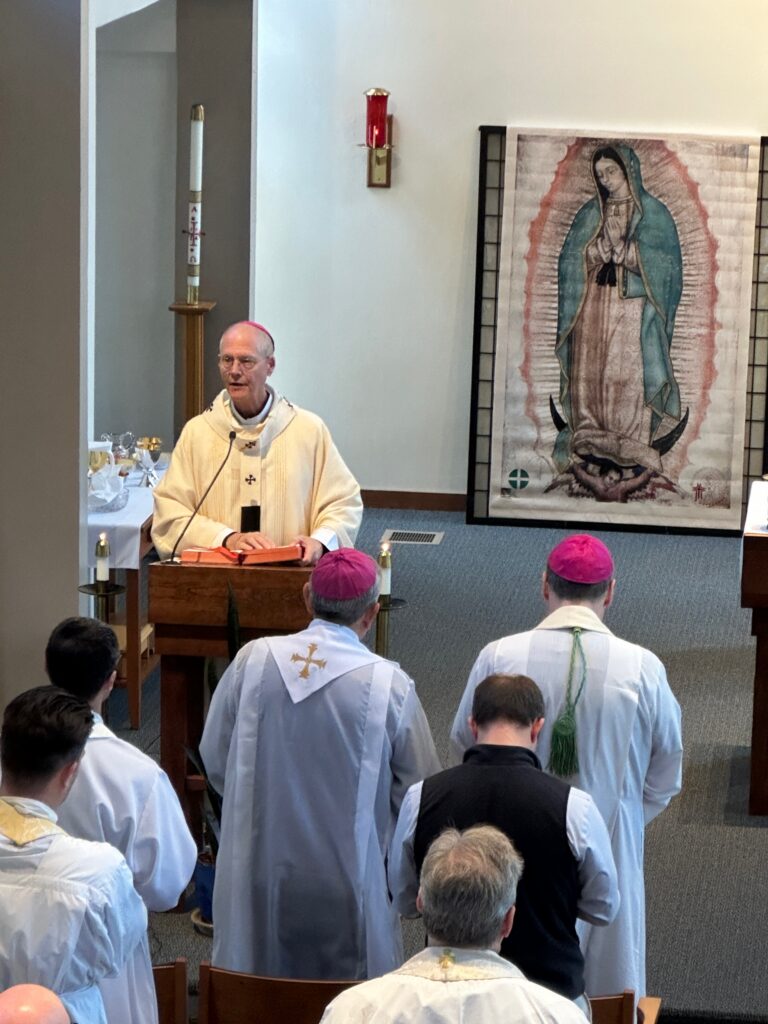
Thursday: Philippians 3:3-8a | Psalm 105 | Luke 15:1-10
Our readings today, reveal the two-way street of the spiritual life: our search for God and God’s relentless search for us.
Psalm 105 gives us the human side: “Let the hearts that seek the LORD rejoice. Look to the LORD in his strength; seek to serve him constantly.” That describes where we are in Partners in the Gospel. We are searching for the best way to structure our parishes, use our resources, and proclaim Jesus Christ more effectively.
But there is a danger: the search for a plan can replace the search for God. The Psalm brings us back to what is essential: Seek the Lord. Seek his strength. Seek his face. So, before Partners is a planning exercise, it must be a spiritual exercise.
As priests, we must deepen our relationship with Christ and allow his loving gaze to shape the way we see the people we serve. Brothers, in the midst of the many challenges of this moment – always allow yourself to be renewed in the Lord’s love and appreciation for you!
While the Psalm tells us to seek the Lord; Jesus reminds us in today’s Gospel of God’s relentless search for us. The shepherd searches for the lost sheep. The woman searches carefully for the lost coin. Neither stops until what they seek is found.
Christianity is not primarily the story of our heroic search for God. It is the story of God’s relentless search for us. Jesus Christ is God’s search made flesh.
For Partners in the Gospel to be truly about the Gospel, our parish communities must increasingly resemble the shepherd: going out in search of those who are missing. The real measure of Partners is not simply whether we merge structures, balance budgets, adjust Mass schedules, or create efficient staffing models. Those may be necessary, but they are means, not the mission.
The more demanding question is: Who are we searching for? Who no longer comes to Mass? Who has never truly encountered Christ? Who feels alienated from the Church? Who is poor, lonely, wounded, grieving, or forgotten? Who is waiting for the Church to notice them?
The goal of Partners is not simply fewer structures. It is more mission: serving God’s people, proclaiming Christ, and extending God’s mercy.
Saint Paul adds another necessary dimension. He names all the things in which he once placed his security, and then says: “Whatever gains I had, these I have come to consider a loss because of Christ.” He had discovered “the supreme good of knowing Christ Jesus my Lord.”
This helps us speak honestly about the losses people experience through Partners. People love their parishes, church buildings, Mass times, traditions, and communities. Those attachments are not wrong; they are often the fruit of love.
But Paul asks whether even things we legitimately treasure can be surrendered when Christ calls us toward something greater. Buildings matter. Traditions matter. But Christ matters more. The supreme good is knowing Christ, belonging to Christ, and bringing others to Christ.
The Gospel begins with grumbling but ends with rejoicing: “Rejoice with me.” Change naturally brings anxiety, resistance, and sometimes grumbling. But the Gospel calls us beyond grumbling and into mission.
Partners in the Gospel asks us to seek the Lord together so that, renewed in Christ, we can join Christ in seeking those he came to save. In the end, its success will not be measured primarily by what we reorganized or what we had to let go. It will be measured by whether more people encounter Jesus Christ and come to know the life and salvation he offers.
0
0 Comments