Ash Wednesday Homily – 2026
I recently came across a quote from Flannery O’Connor that seems especially fitting as we begin our Lenten journey this Ash Wednesday. She wrote: “All human nature vigorously resists grace, because grace changes us—and the change is painful.”
As we begin Lent, I recognize the truth of those words not just in theory, but in myself. There is a part of me this year that does not feel quite ready for Lent. I sense a resistance within—a hesitancy toward the conversion and change God desires to work in me. Perhaps you recognize something similar in your own heart. It may be best described as an aversion to the grace being offered.
And yet, there is another truth that the Church has long held before us. St. Thomas Aquinas teaches that grace does not destroy our nature, but perfects it. Grace builds upon nature. In other words, God works with what is already there. Even when we resist, there remains within us a deeper longing—a desire for healing, for prayer, for renewed relationship with God and with one another.
From that place, I know how much this season of Lent matters. I know the importance of addressing and removing the roadblocks that interfere with my relationship with God and others. I long for more time to pray, for extended moments of silence in which I can listen for the voice of the Lord. I welcome the stirrings of the Holy Spirit, who is clearly at work in our world, in our Church, and in our lives in these very days.
But spiritual renewal is never a solo journey. It is not something we do alone or in isolation. What is the purpose of our spiritual practices if not to draw us more deeply into communion with God—and, through God, into communion with one another?
The prophet Isaiah reminds us that true fasting and penance are not merely private disciplines. They involve lifting the burdens others carry, attending to the suffering of the poor, the homeless, and the oppressed. These are the practices that allow light to break into the darkness and that bring delight to our God. This is the kind of conversion that transforms not only hearts, but communities.
In our first reading today, the prophet Joel reminds us that we have a gracious and merciful God, slow to anger and rich in kindness. St. Paul, in the second reading, urges us with urgency and love: “Be reconciled to God.” God has reconciled us to himself through his Son, Jesus Christ. This reconciliation is not earned. It is unmerited love—pure gift, pure grace.
Lent, then, is a time to be renewed in the mercy and love of God, and to become instruments—conduits—of that same mercy and love for others.
Flannery O’Connor names honestly the resistance we experience when faced with the real challenge of living as disciples of Jesus Christ. At the same time, St. Thomas Aquinas assures us that the immeasurable grace of Jesus Christ awaits us—not only at the end of Lent, but here and now. As St. Paul tells us, “Whoever is in Christ is a new creation.”
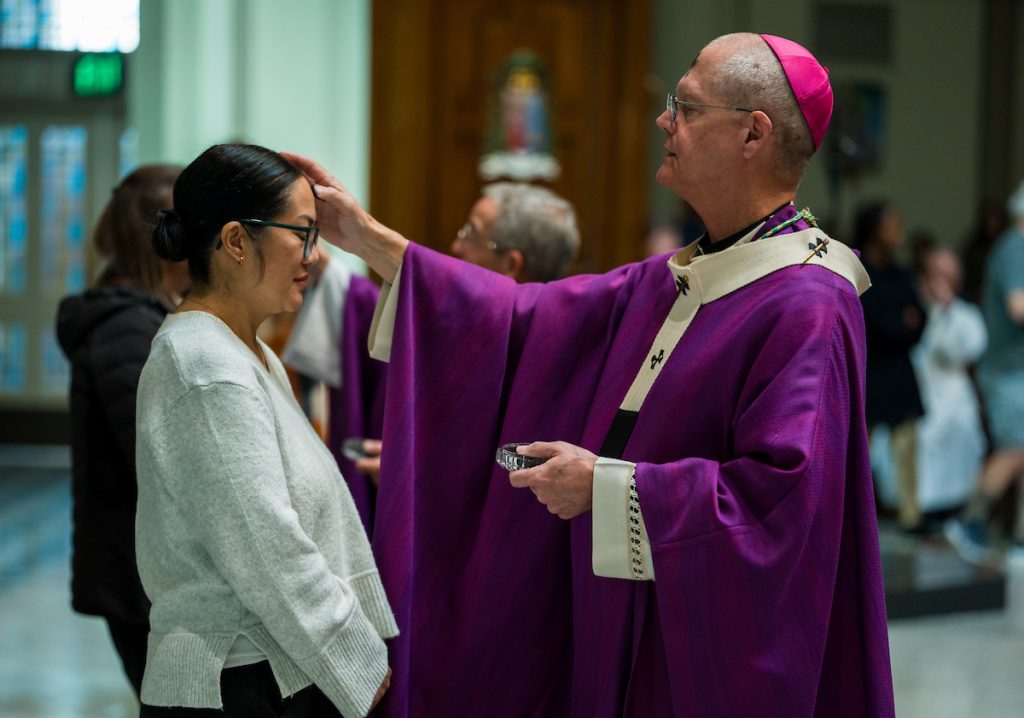
In a few moments, ashes will be placed on our foreheads. They are dry and fragile. They brush away easily. Yet they speak a profound truth. We are dust, and to dust we shall return. But we are also dust deeply loved by God. This holy season invites the Lord to gently brush aside the dust of bad habits, indifference, and sin that cling to us.
The Christian journey always requires a certain dying to self in order to truly live—because living fully means life in Christ.
This Lent, may we be receptive to the work of grace within us, even when it challenges us, even when it changes us. And may that grace prepare us to celebrate Easter as a people made new—a new creation in Christ.